LATEST · Fashion
Korean fashion deserves more than a shopping list
Vogue Australia’s K-fashion edit raises a larger question: when does international visibility become genuine understanding of a design culture?
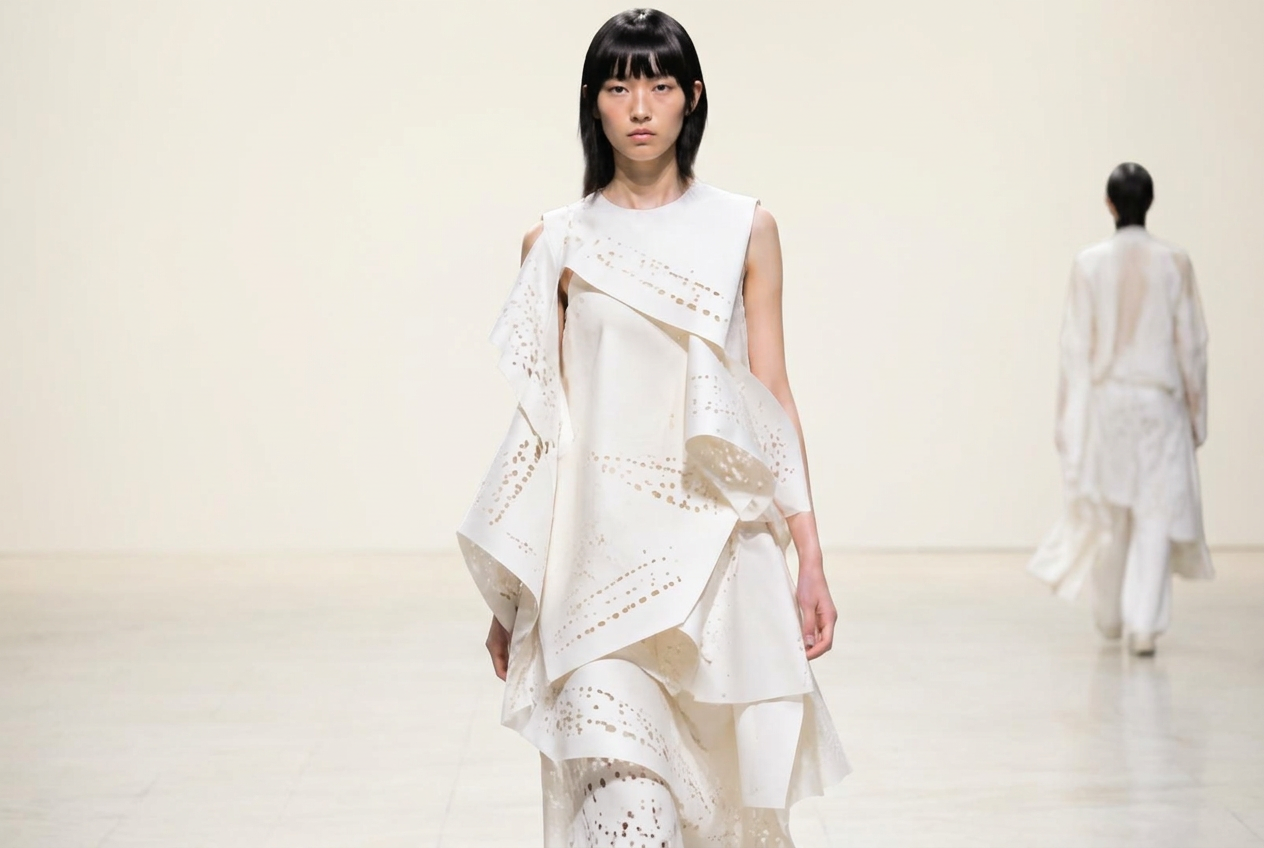
A jacket can look immaculate on a phone and feel entirely unremarkable on the body. The shoulder holds no tension; the cloth has none of the weight the photograph suggested. I keep that distinction in mind whenever fashion’s next shopping list arrives, particularly when an entire country supplies the organising principle.
Vogue Australia’s headline, “20 of the best K-fashion brands to add to your closet”, offers a familiar invitation: discover, desire, buy. It also provides an occasion to ask what happens when Korean fashion travels through the language of the recommendation. A list can open a door. Whether we look beyond the threshold is another matter.
The prefix is not the proposition
“K-fashion” is useful shorthand, but I find it increasingly inadequate as criticism. It tells us where to look without necessarily telling us what we are looking at. The precision of a lapel, the deliberate awkwardness of a proportion, the relationship between a garment and the person wearing it: these are more revealing than a national prefix.
Consider the distance between Juun.J’s experiments with volume and Wooyoungmi’s treatment of the tailored wardrobe. Both belong in a conversation about Seoul’s design culture; neither becomes more intelligible simply by being placed beneath the same banner. International coverage should make those distinctions sharper. Otherwise, recognition risks becoming another kind of flattening, with Korean identity treated as a shared aesthetic rather than the ground from which different practices emerge.
Look past the image
My interest begins where the shopping thumbnail ends. How does a sleeve fall when the arm is lowered? Does an oversized coat have an internal architecture, or merely extra fabric? Is a distressed surface integral to the design, or decoration applied to make a familiar shape register as new? Those questions are hardly exclusive to Korea. That is precisely the point.
Korean labels deserve the same scrutiny afforded to an Antwerp designer or a Paris house: attention to cut, fabrication, references and continuity across collections. Celebrity visibility and a persuasive campaign may introduce a label, but neither can explain the hand of its cloth. I would rather read a close account of one well-resolved trouser than twenty variations on the promise of cool.
Discovery needs a second act
There is nothing inherently slight about service journalism. For a reader encountering Korean designers for the first time, a clear buying guide can be genuinely useful. The responsibility comes in what accompanies that invitation: sizing information, fabric composition, production details where available, and some explanation of why a particular designer matters beyond the current image cycle.
The Vogue Australia headline signals an appetite worth taking seriously, not dismissing. My reservation is with the wider editorial habit of mistaking access for understanding. Korean fashion does not need to be presented as a single wardrobe waiting to be acquired. It needs sustained looking, specific language and the freedom to be uneven, difficult or restrained. Buy the jacket, certainly. But first, ask what makes its shoulder worth remembering.
East Asia · Reported from Vogue Australia. Source attribution provided by the Coush desk.